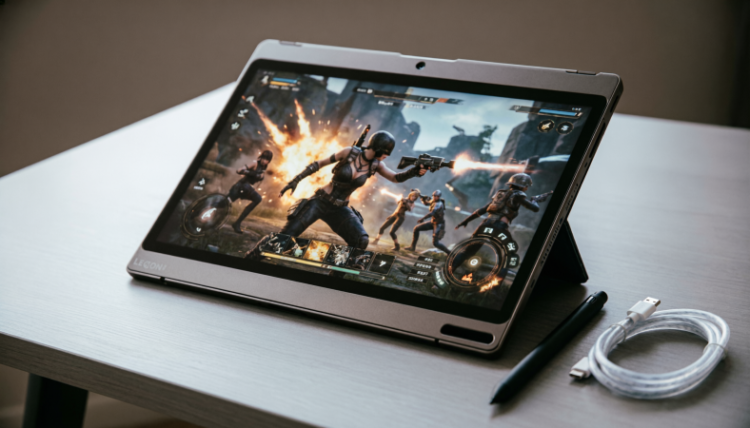
Digimagaz.com – The gaming laptop market in 2025 has entered a new chapter with the arrival of NVIDIA’s RTX 50 Series GPUs. Among the first to showcase this next-generation technology is the Lenovo Legion Pro 7i (2025), a high-end machine that combines raw gaming power with a refined design. But while it carries some of Lenovo’s signature strengths, this year’s model also makes a few bold decisions that may not appeal to everyone.
Design and Build Quality
At first glance, the Legion Pro 7i (2025) stays true to the industrial, battle-ready look that Lenovo has cultivated across its Legion line. The chassis is crafted from aluminum, ensuring durability without excessive bulk. Lenovo continues with its extended rear section that houses cooling vents and angled fins, giving the device a distinctly aggressive gaming aesthetic.
One noticeable design change, however, is the relocation of all I/O ports to the sides of the laptop. Unlike its predecessor, which offered rear-facing ports for better cable management, this model moves everything left or right of the chassis. While convenient for quick access, it may create more clutter for gamers using external mice and accessories.
The keyboard remains full-sized with a numeric pad, a rarity among modern gaming laptops where many manufacturers have shifted toward compact layouts. For productivity, it’s a plus. For gamers preferring a more streamlined typing experience, the extra keys may feel unnecessary.
Display: OLED Brilliance
The Legion Pro 7i sports a 16-inch OLED panel with a QHD+ (2560 x 1600) resolution. OLED technology continues to set a high bar for gaming visuals, offering deep blacks, sharp contrast, and vivid color reproduction. While glossy screens may reflect ambient lighting, the payoff in image quality is undeniable.
Gamers will also appreciate the 16:10 aspect ratio, which provides extra vertical space—a welcome feature for both gaming and multitasking. Although the hinge doesn’t extend to 180 degrees, the form factor feels balanced for daily use.
Performance and Gaming Experience
As one of the first laptops to ship with an NVIDIA GeForce RTX 5080 GPU and Intel Core Ultra 9 275HX CPU, the Legion Pro 7i demonstrates just how far portable gaming has advanced. Benchmarks place its performance between 60 fps and 145 fps at QHD+ resolution across modern titles, including demanding ray-traced games.
Titles such as Doom: The Dark Ages and Battlefield 6 Open Beta ran smoothly, with the OLED screen amplifying immersion through punchy contrast and rich detail. For competitive players, this performance translates into fluid gameplay even without relying on NVIDIA’s upscaling technologies.
Cooling and Acoustics
Despite its high-performance components, Lenovo’s cooling system handles thermal output impressively well. The undercarriage pulls in air through the center and pushes heat out the back, keeping fan noise lower than expected for a gaming powerhouse. Importantly, coil whine—a common nuisance in high-powered laptops—was nearly absent during testing.
Battery Life
Battery life is far from a selling point, with the Pro 7i averaging around 6.5 hours per charge under light workloads. Gamers will need to stay plugged in for extended sessions, which is expected for a system of this caliber.
Software and Usability
One drawback lies in Lenovo’s pre-installed software. Users are greeted with promotional pop-ups and bundled apps immediately after boot-up, a frustration for those expecting a premium out-of-the-box experience. While not unique to Lenovo, it stands out more at this price point.
Price and Competition
The Lenovo Legion Pro 7i retails at approximately RM13,230, positioning it firmly in the premium tier.
Competitors in this space include:
-
ASUS ROG Zephyrus G16 (2025): Powered by an Intel Core Ultra 9 285H and up to an RTX 5090 GPU, this model offers similar display specs but commands a higher price, around RM16,299.
-
MSI Stealth 16 (2025): Equipped with up to an RTX 5070 and a massive 99.9Wh battery, the Stealth 16 emphasizes portability without compromising on OLED visuals.
Compared to these, the Legion Pro 7i offers a balance of cutting-edge GPU power, premium display quality, and slightly more approachable pricing—though still far from budget-friendly.
Final Verdict
The Lenovo Legion Pro 7i (2025) represents a milestone for Lenovo, being among the earliest laptops to integrate NVIDIA’s RTX 50 Series GPUs. Its combination of robust build quality, OLED display, and elite performance makes it an undeniable contender for serious gamers and creators.
However, its compromises—particularly the side-only ports, pre-installed bloatware, and average battery life—may give some buyers pause. At its core, this machine is not designed for everyone. It is crafted for those who want the very best in mobile gaming performance and are willing to pay a premium for it.
If you value cutting-edge visuals and next-generation GPU performance, the Legion Pro 7i (2025) is one of the most impressive gaming laptops you can buy today.