Digimagaz.com – Samsung’s latest experiment in foldable technology is not just another iteration—it is a bold attempt to redefine what a smartphone can be. The Galaxy Z TriFold introduces a triple-folding design that blurs the line between phone and tablet, signaling a new phase in mobile productivity and device engineering.
Rather than focusing purely on novelty, Samsung appears to be testing a serious question: can a single device truly replace both a smartphone and a tablet without compromise?
A New Form Factor That Changes the Conversation
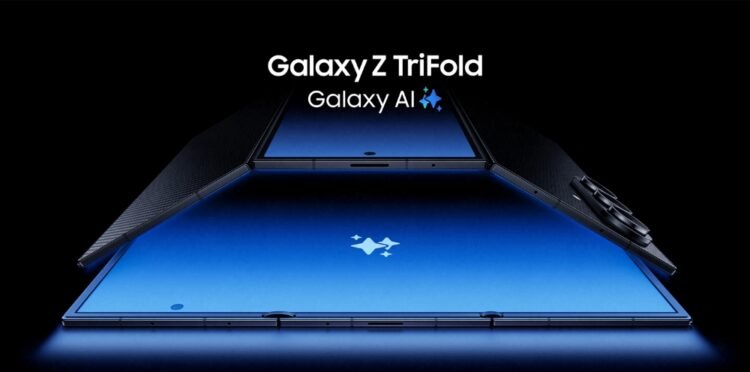
For years, foldable phones have promised versatility, but most models have remained variations of the same idea. The Galaxy Z TriFold breaks that pattern by expanding into a three-panel design that unfolds into a near 10-inch display while remaining pocketable when folded.
This design evolution reflects how far foldable technology has progressed since Samsung’s early Fold devices, which were criticized for fragility and bulk. The TriFold feels less like an experiment and more like a mature product built on years of refinement in hinges, materials, and display durability.
From a practical standpoint, the triple-fold approach delivers something traditional foldables cannot: a genuinely tablet-sized workspace without the need for a separate device.
Engineering Over Spectacle
What stands out about the Galaxy Z TriFold is not just its size, but how carefully engineered it feels. Samsung’s folding mechanism prioritizes screen protection, guiding users to fold the device in a specific sequence to avoid damage. This detail highlights a shift in Samsung’s strategy—from showcasing futuristic concepts to ensuring real-world usability.
When unfolded, the device is remarkably thin and flat, with minimal visible creases. Folded, it feels solid and compact, though heavier than standard flagship phones. This trade-off underscores a key reality of next-generation foldables: versatility often comes at the cost of weight and price.
Display Experience Built for Multitasking
The TriFold’s dual-display system plays a central role in its identity. The outer screen functions like a conventional smartphone display, while the expansive inner panel transforms the device into a productivity tool.
The larger display opens new possibilities for multitasking, split-screen workflows, and AI-driven features. Compared with standard smartphones, the TriFold offers a more natural environment for creative tasks, document editing, and collaborative work.
In many ways, it represents Samsung’s vision of a post-smartphone era, where mobile devices are designed around productivity rather than just communication.
Camera System: Flagship Power With Limitations
Samsung continues its trend of equipping foldables with premium camera hardware, led by a high-resolution main sensor. Image quality is expected to rival top-tier Galaxy devices, reinforcing the idea that foldables no longer require compromises in photography.
However, the zoom capabilities remain conservative compared to some competitors. For power users who prioritize long-range photography, this may feel like a missed opportunity.
Still, the overall camera setup reflects Samsung’s focus on balanced performance rather than experimental hardware.
Performance, AI, and the Enterprise Angle
Under the hood, the Galaxy Z TriFold is positioned as a performance-driven device. With a flagship chipset, generous memory, and AI integration from both Samsung and Google, it targets users who demand more than casual smartphone performance.
The large display also amplifies the impact of AI features, particularly in editing, multitasking, and contextual assistance. This suggests that the TriFold is not just aimed at consumers but also at professionals and enterprise users who need a portable productivity hub.
Yet, the lack of expandable storage options raises questions about whether Samsung fully embraced the needs of power users.
The Price Question and Market Reality
Perhaps the most controversial aspect of the Galaxy Z TriFold is its expected price. Early estimates place it in the same range as premium laptops, which could limit its appeal to mainstream consumers.
However, comparing the TriFold to conventional smartphones misses the point. Samsung is positioning it as a hybrid device—part phone, part tablet, and part productivity tool. If users view it as a replacement for multiple devices, the cost becomes easier to justify.
Still, widespread adoption will depend on whether consumers are ready to pay a premium for this level of versatility.
Why the Galaxy Z TriFold Matters
The Galaxy Z TriFold is not just another foldable phone—it is a statement about the future of mobile devices. It demonstrates that foldables are evolving beyond novelty into serious tools that challenge traditional device categories.
While it may not be perfect, the TriFold represents a turning point. It shows that the next generation of smartphones may not be defined by thinner bezels or faster chips, but by entirely new ways of interacting with technology.
If Samsung’s gamble pays off, the Galaxy Z TriFold could mark the beginning of a new era where one device truly does it all.