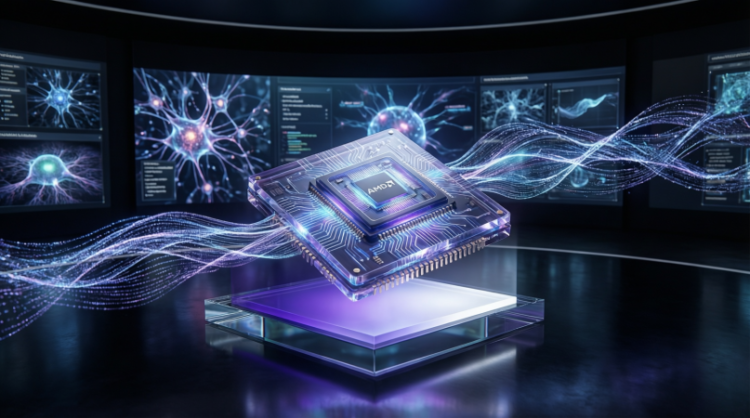




Digimagaz.com – At CES 2026 in Las Vegas, AMD signaled that it is no longer content playing a secondary role in the AI data center race. During her keynote address, CEO Lisa Su unveiled Helios, a next-generation AI rack-scale system that AMD is positioning as a direct challenger to Nvidia’s dominance in large-scale AI infrastructure.
Su did not hedge her words. Standing beside a full Helios rack unit on stage, she described it as the world’s best AI rack, an unmistakable challenge to Nvidia, which has set the pace in rack-scale computing with its NVL systems. The message was clear: AMD wants hyperscalers and enterprises to see it as a true alternative at the highest level of AI deployment.
A Direct Response to Nvidia’s Rack-Scale Lead
Helios is designed to compete head-to-head with Nvidia’s latest Vera Rubin NVL72 system, which also debuted at CES 2026. Both platforms share a similar architectural ambition. Each rack integrates 72 high-performance GPUs, signaling that AMD is matching Nvidia not just in intent but in scale.
In Helios, those 72 GPUs are AMD’s MI455X accelerators, while Nvidia’s system relies on its Rubin architecture. While AMD did not disclose full performance benchmarks during the keynote, the company framed Helios as a purpose-built platform for large language models, generative AI, and other compute-intensive workloads that increasingly demand rack-scale optimization rather than standalone servers.
This focus matters. As AI models grow in size and complexity, performance gains increasingly come from tightly integrated systems that minimize latency and maximize data movement across GPUs. Nvidia has benefited from being early to this approach. Helios suggests AMD believes it can now compete on similar terms.
The MI500 Series and an Aggressive Performance Claim
Beyond Helios itself, AMD used the CES stage to outline its broader roadmap for AI acceleration. Central to that strategy is the upcoming MI500 series of data center GPUs. According to AMD, these chips are expected to deliver up to a 1,000x increase in AI performance compared to the MI300X generation.
That figure is ambitious, and AMD did not break down exactly how it is calculated. Such claims typically reflect a combination of architectural improvements, software optimization, and gains across multiple AI workloads rather than a single benchmark. Still, the statement underscores AMD’s belief that incremental improvements will not be enough in the years ahead.
Su framed this in stark terms. AMD expects that within five years, roughly 5 billion people will interact with AI systems on a daily basis. Supporting that level of usage, she argued, will require a 100x increase in global computing capacity. If that projection proves even partly accurate, the demand for data center hardware would dwarf today’s market.
Why Helios Matters for the AI Ecosystem
Helios is more than a single product announcement. It represents AMD’s attempt to shift how customers perceive its role in AI infrastructure. Historically, AMD has found success by undercutting Nvidia on price or offering competitive performance in specific niches. Rack-scale systems, however, are about ecosystem trust, long-term roadmaps, and software maturity.
By unveiling a full rack solution, AMD is signaling that it wants to sell platforms, not just chips. This aligns with the purchasing behavior of hyperscalers and large enterprises, which increasingly favor integrated systems that can be deployed quickly and scaled predictably.
It also raises the stakes for competition. Nvidia’s advantage has not only been hardware performance but also its tightly coupled software stack and developer ecosystem. For Helios to succeed, AMD will need to convince customers that its hardware, software, and long-term support can meet the same expectations at scale.
Investors Are Paying Attention
The market has already rewarded AMD for its growing presence in AI. Over the past 12 months, the company’s stock has risen 76 percent, outpacing even Nvidia’s strong 30 percent gain over the same period. While stock performance reflects many factors, it suggests that investors see AMD’s AI strategy as more than aspirational.
Helios adds credibility to that view. It shows AMD moving aggressively into the most demanding segment of the AI infrastructure market, where margins are high and customer relationships tend to be long-lasting.
A More Crowded Future for AI Data Centers
CES 2026 made one thing clear: the AI data center market is entering a new phase. Nvidia may still set the pace, but it no longer has the field to itself. With Helios and the forthcoming MI500 series, AMD is betting that the next wave of AI growth will be large enough to support more than one dominant player.
If the demand projections outlined by Lisa Su come close to reality, that bet may prove well-timed.