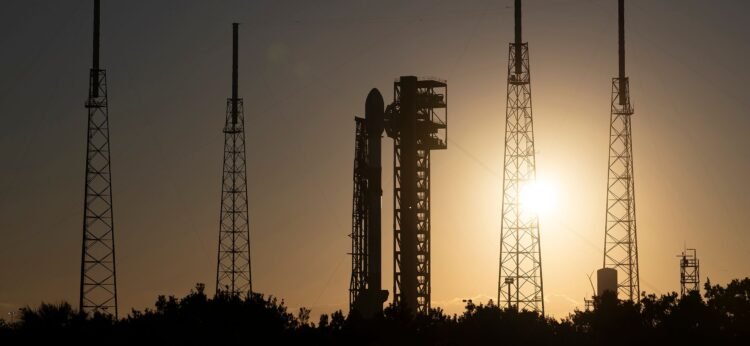

Digimagaz.com – SpaceX is set to extend its record-breaking launch cadence with another late-night Falcon 9 mission from Florida, underscoring how routine orbital access has become for the company’s Starlink program.
The upcoming flight, known as Starlink 6-82, is scheduled to lift off from Cape Canaveral Space Force Station late Sunday evening. If all goes according to plan, the mission will mark SpaceX’s 580th Falcon 9 launch overall, a milestone that reflects more than a decade of continuous refinement of the reusable rocket system.
This mission will deploy 29 Starlink V2 Mini satellites into low Earth orbit, adding fresh capacity to the company’s global broadband network. It is also SpaceX’s 120th Starlink launch this year alone, highlighting how the constellation has evolved from an experimental project into a core part of the company’s business model. With each batch of satellites, SpaceX continues to improve network resilience, coverage density, and data throughput, particularly in regions with limited terrestrial infrastructure.
Liftoff is scheduled for 10:14 p.m. Eastern Standard Time, with the rocket departing Space Launch Complex 40 on a southeast trajectory. While the timeline is firm, weather remains a significant variable. Forecasts from the U.S. Space Force’s 45th Weather Squadron indicate only a 30 percent chance of favorable conditions during the opening of the launch window. A passing cold front combined with strong high pressure over the Ohio Valley is expected to generate increasing northerly winds as the night progresses. These low-level winds are the primary concern, as they could exceed Falcon 9 liftoff constraints. There is also a smaller risk that coastal showers could interfere with flight rules related to cloud cover.
Beyond launch conditions, recovery weather in the Atlantic is also being closely monitored. SpaceX plans to reuse the Falcon 9 first stage, continuing its long-standing emphasis on booster recovery as a way to reduce launch costs and turnaround time.
The mission will fly on booster B1092, which is making its ninth trip to space. This particular stage has previously supported a mix of cargo, navigation, and national security missions, including CRS-32, GPS III-7, and USSF-36. Its reuse on a Starlink flight reflects SpaceX’s flexible approach to fleet management, where boosters are regularly rotated across different mission types.
Just over eight minutes after liftoff, B1092 is expected to attempt a landing on the drone ship A Shortfall of Gravitas stationed in the Atlantic Ocean. A successful touchdown would represent the 137th landing on that vessel and the 551st booster recovery achieved by SpaceX overall. Each recovery further reinforces the reliability of the company’s reusable launch architecture, which has become a defining feature of modern spaceflight.
As SpaceX continues to accelerate its launch schedule, missions like Starlink 6-82 illustrate how orbital deployments that once drew intense scrutiny are now approaching operational normalcy. Still, with challenging weather and precise recovery targets, each flight remains a complex engineering exercise, even in an era where launches are happening at an unprecedented pace.