Digimagaz.com – Capcom’s latest entry, Resident Evil Requiem, does more than introduce another stylish villain. It reignites one of the franchise’s oldest obsessions: legacy. And at the center of that conversation is Zeno, a sharply dressed antagonist whose similarities to Albert Wesker are too deliberate to ignore.
Fans are asking the obvious question. Is Zeno a reborn Wesker, a copy, or something even more calculated?
Here’s a closer look at the evidence, the timeline, and what Zeno could signal about the direction of the series.
The Wesker Shadow Still Looms Large
To understand Zeno, we need to revisit Wesker’s fate.
Wesker’s story concluded in Resident Evil 5, where prolonged exposure to the Uroboros Virus pushed him beyond control. His final confrontation ended in spectacular fashion inside a volcano. In franchise terms, that was definitive. Wesker is dead.
So Zeno is not the original S.T.A.R.S. captain. But Capcom clearly wants us to feel the connection.
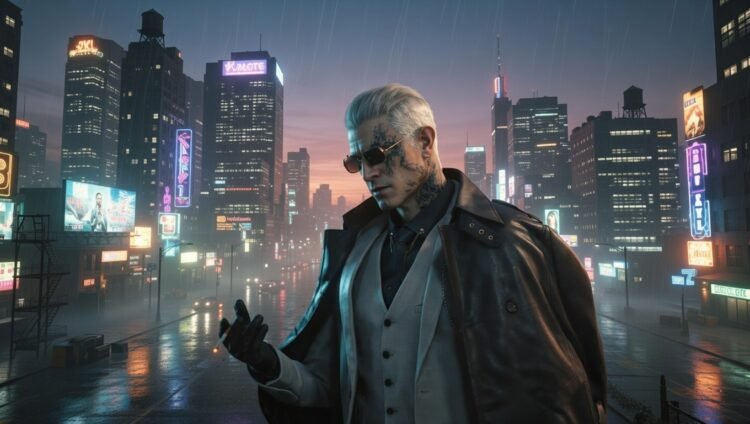
Zeno mirrors Wesker’s cold composure, superhuman speed, and preference for firearms. He also projects that same calculated superiority that defined Wesker’s presence across earlier titles. The resemblance is not accidental. It is thematic.
Yet there are differences. Zeno’s white three piece suit contrasts with Wesker’s darker aesthetic. More importantly, he displays visible mutations: dark, vein-like markings across his face and neck.
That detail may be the key.
The Raccoon City Link
The markings resemble symptoms tied to latent viral exposure linked to the 1998 Raccoon City outbreak. The concept of dormant infection, sometimes referred to in-game as “Raccoon City Syndrome,” suggests that survivors may carry mutated viral remnants for years before symptoms surface.
That raises two important possibilities.
First, Zeno may not be engineered from scratch. He could be someone whose biology was altered long ago and only recently triggered.
Second, his condition connects him thematically to veteran characters like Leon S. Kennedy, who also endured the Raccoon City disaster.
If Requiem is about consequences catching up to survivors, Zeno may represent the ultimate delayed mutation.
Theory 1: A Product of The Connections
One of the most compelling explanations points to The Connections, the shadowy group introduced in Resident Evil 7: Biohazard.
Unlike Umbrella’s corporate ambition, The Connections operate in deeper secrecy. If they gained access to Wesker’s genetic data, cloning would not be out of character. A manufactured “Wesker-type” bioweapon could serve as both psychological warfare and battlefield asset.
There is also narrative precedent. The franchise has explored replication and engineered superhumans before. Zeno being labeled an “imitation” within the campaign strengthens this angle. He may not believe he is a clone, but others might know better.
Theory 2: A Lost Candidate of Project W
Another possibility leads back to Oswell E. Spencer and his infamous Project W.
The program experimented on select children to create superior humans. Officially, only two candidates survived: Albert and Alex Wesker. But in a franchise built on hidden files and classified experiments, “official” rarely means complete.
Zeno could be an undocumented survivor. That would explain the physical resemblance and shared abilities without requiring direct cloning. It would also expand the Project W mythology, opening narrative space for more engineered elites.
Theory 3: Spencer’s True Legacy
Requiem introduces the concept of “Elpis,” described as part of Spencer’s long-term vision. Spencer famously sought to transcend human limitation and reshape evolution itself.
If Spencer pursued self-cloning to preserve his consciousness or ideology, Zeno could be the result. A younger, enhanced vessel carrying fragmented memories would align with Spencer’s obsession with immortality.
There is irony here. Wesker ultimately killed Spencer. For Spencer to return in a body resembling Wesker would be a twisted narrative loop, reinforcing the franchise’s recurring theme: ambition consuming its architect.
Theory 4: A Symbol, Not a Copy
There is another interpretation worth considering. Zeno may not be genetically tied to Wesker at all.
Instead, he could be an intentional echo. A character designed to embody the psychological imprint Wesker left on the world. The white suit. The composure. The god complex. All curated.
If Requiem is examining how bioterrorism ideology survives beyond its founders, then Zeno represents inheritance rather than resurrection.
This reading positions him as commentary. Evil evolves, adapts, and borrows from the past.
Why Zeno Matters to the Franchise
For nearly three decades, the Resident Evil series has revolved around scientific overreach and manufactured evolution. From Tyrants to Nemesis units, the core idea has remained consistent: someone always believes they can perfect humanity.
Zeno fits into that lineage while modernizing it.
His presence suggests that the franchise is shifting from corporate villainy to ideological persistence. Umbrella may be gone, but its philosophy lives on. Organizations change names. Viruses evolve. The ambition to “improve” humanity never disappears.
Requiem appears less interested in shock value and more invested in legacy.
The Bigger Picture
Veteran characters like Leon and FBI agent Grace Ashcroft ground the story in continuity, but Zeno pushes the narrative forward. He forces long-time fans to confront an uncomfortable idea: the Wesker era never truly ended.
Whether clone, candidate, or calculated homage, Zeno is not simply copying the past. He is testing whether the series can reinterpret its most iconic villain for a new generation.
And that may be the most unsettling twist of all.
In survival horror, monsters rarely stay buried.