
Table of contents:
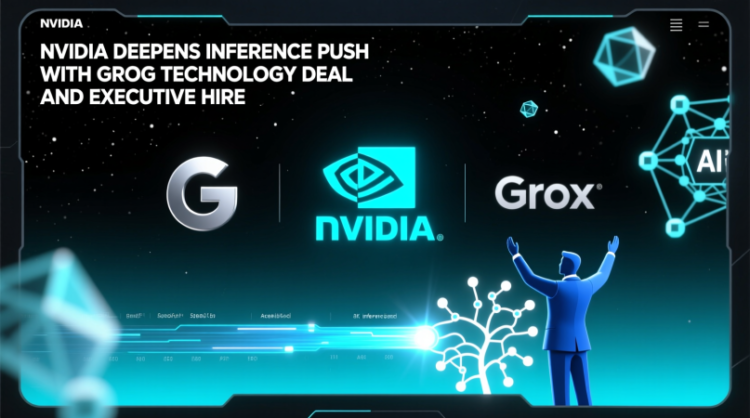
Digital Magazine – Nvidia is taking a more nuanced approach to strengthening its position in artificial intelligence, opting for licensing and leadership recruitment rather than a full acquisition. The chipmaker has agreed to license inference-focused chip technology from AI startup Groq and bring Groq’s top executives into its own ranks, a move that highlights how competition in AI hardware is evolving beyond model training.
The agreement gives Nvidia access to Groq’s inference technology under a non-exclusive license while allowing Groq to continue operating as an independent company. At the same time, Groq founder Jonathan Ross, a key figure behind Google’s early AI chip efforts, along with President Sunny Madra and several engineers, will join Nvidia. Financial terms were not disclosed.
This structure fits a broader pattern emerging across Big Tech. Rather than acquiring startups outright, dominant firms are increasingly securing intellectual property and talent through licensing deals and targeted hires. The strategy can be faster, less risky, and often easier to defend against regulatory scrutiny than traditional mergers.
Why inference matters now
Nvidia’s dominance in AI training hardware is well established, but inference has become the next battleground. Inference refers to the stage where trained AI models generate responses to real-world queries, powering chatbots, search tools, and enterprise applications. As AI usage scales, inference workloads are growing rapidly and placing new demands on efficiency, cost, and latency.
This shift has opened the door to competitors. Advanced Micro Devices has been positioning its accelerators as lower-cost alternatives, while startups like Groq and Cerebras Systems are rethinking chip architecture entirely. Unlike Nvidia’s reliance on external high-bandwidth memory, Groq designs its chips around on-chip SRAM, reducing dependence on a global memory supply chain that has been under strain.
That design choice can dramatically speed up response times for certain AI tasks, a key advantage for real-time applications. The tradeoff is scale. SRAM-based systems can struggle to serve very large models, limiting flexibility compared with Nvidia’s more general-purpose platforms. For Nvidia, licensing Groq’s technology offers insight into these alternative architectures without committing to them as a core replacement.
Talent without takeover
The leadership transition is as significant as the technology itself. Jonathan Ross’s move brings deep experience in custom AI silicon at a time when Nvidia is racing to defend its lead. Hiring seasoned executives from rivals has become a favored tactic among tech giants, effectively absorbing expertise while avoiding the cost and complexity of full acquisitions.
Recent examples underline the trend. Microsoft structured a deal with an AI startup as a licensing arrangement that brought in its top executive. Meta spent billions to hire Scale AI’s CEO without buying the company. Amazon and Nvidia have both used similar approaches this year. Regulators have taken notice, but none of these deals have been reversed.
Analysts see antitrust risk as the main variable. By keeping the Groq license non-exclusive and maintaining Groq as an independent entity, Nvidia can argue that competition remains intact. Critics counter that when leadership and engineering talent migrate, independence can become more symbolic than practical.
Groq’s future as an independent player
Groq says it will continue operating under new CEO Simon Edwards, with its cloud business intact. The company has strong momentum, having more than doubled its valuation to $6.9 billion after a $750 million funding round in September. That growth reflects rising demand for alternatives to Nvidia’s ecosystem, particularly in regions seeking diversified AI infrastructure.
Groq and Cerebras have both secured major deals in the Middle East, where governments and enterprises are investing heavily in AI capacity. Cerebras is reportedly preparing for a potential public offering as soon as next year, which could further spotlight this niche of inference-focused hardware.
For Groq, independence offers optionality. It can keep selling to customers who want Nvidia alternatives while benefiting indirectly from Nvidia’s validation of its technology. The challenge will be retaining momentum after losing key leaders to its largest potential partner and competitor.
Nvidia’s long-term calculation
Nvidia CEO Jensen Huang has repeatedly argued that the company can extend its leadership as AI shifts from training to inference. Licensing Groq’s technology supports that narrative. Rather than betting on a single architecture, Nvidia appears to be hedging, learning from challengers while reinforcing its own platform.
The move also signals confidence. Nvidia does not need to buy Groq outright to neutralize a threat or capture value. By selectively integrating technology and talent, it can adapt quickly as inference workloads grow more diverse.
Still, the deal underscores how fragmented the AI hardware market is becoming. Training may remain Nvidia’s stronghold, but inference is shaping up as a more competitive and experimental space. How effectively Nvidia blends external ideas like Groq’s with its own roadmap will help determine whether it can dominate not just how AI models are built, but how they are ultimately used.