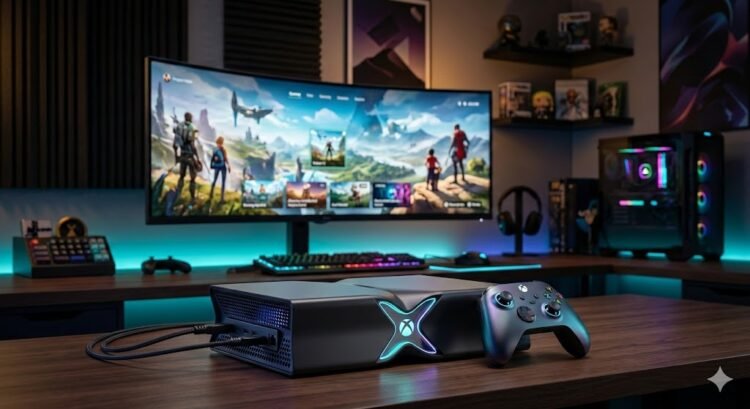

Microsoft has officially confirmed Project Helix as the codename for its next-generation Xbox system, marking the company’s first public step toward the era beyond the current consoles such as the Xbox Series X and Xbox Series S.
The announcement, shared by leadership from Microsoft’s gaming division, highlights an ambitious goal: the new platform will be able to run both Xbox and PC games natively. If delivered as promised, that capability could reshape how players think about console ecosystems and signal a deeper convergence between console hardware and the Windows PC environment.
Rather than acting as a conventional hardware refresh, Project Helix appears designed to redefine the boundaries between living-room consoles and desktop gaming.
A Console Built Around Both Xbox and PC Libraries
The most striking claim about Project Helix is its ability to run games from both Xbox and PC ecosystems. For years, Microsoft has gradually pushed its gaming platforms closer together through services like Xbox Game Pass and its long-running Play Anywhere initiative. Project Helix suggests the company is ready to take that integration even further.
In practical terms, a console capable of running PC titles natively could eliminate one of the biggest divides in gaming: platform-specific libraries. Traditionally, PC games and console games have required separate versions because of differences in hardware architecture, input methods, and distribution platforms.
With Helix, Microsoft appears to be pursuing a shared software layer that allows both environments to coexist on the same hardware.
For players, that could translate into:
-
Access to a much larger game library from day one
-
Greater flexibility between keyboard-and-mouse and controller input
-
Easier cross-platform play and cloud save integration
For developers, a unified system may simplify the process of launching games simultaneously across PC and console.
Technical Challenges Behind PC Game Compatibility
While the idea of running PC games on a console sounds straightforward, several technical hurdles remain.
PC games are typically built around open ecosystems that include multiple storefronts, customizable graphics settings, and a wide variety of hardware configurations. If Project Helix supports PC titles directly, Microsoft will likely need to address several areas:
Storefront integration:
PC games are distributed through platforms such as Steam and Epic Games Store. Microsoft must decide whether Helix supports these stores, offers alternatives, or limits distribution to its own marketplace.
Anti-cheat compatibility:
Many competitive PC titles rely on specialized anti-cheat systems that interact closely with operating systems. Ensuring those systems run securely on a console environment will be critical.
Mod support:
One of PC gaming’s biggest advantages is community modding. Enabling safe mod integration on a console could dramatically expand the appeal of Helix.
Input flexibility:
Games designed around keyboard and mouse controls may require refined controller mappings to work seamlessly in a living-room setup.
If Microsoft manages these elements effectively, Helix could deliver something consoles have rarely offered: the flexibility of PC gaming with the simplicity of a console interface.
Performance Goals and Hardware Direction
Although Microsoft has not disclosed detailed specifications for Project Helix, the company says the platform will “lead in performance.”
Historically, Xbox hardware has relied on custom processors built in collaboration with Advanced Micro Devices (AMD). That partnership has helped maintain compatibility with technologies such as DirectX 12 Ultimate, which powers modern graphical features across both PC and Xbox systems.
Industry observers expect Helix to build on technologies introduced with the current generation, including:
-
High-speed solid-state storage similar to Xbox Velocity Architecture
-
Hardware-accelerated ray tracing
-
Advanced upscaling technologies like FidelityFX Super Resolution
-
Support for frame-generation techniques commonly used in modern PC graphics pipelines
Together, those upgrades could allow Helix to deliver smoother performance and faster load times while maintaining compatibility with older Xbox titles.
Backward compatibility has been a defining feature of Xbox platforms since the days of the Xbox One, and it is widely expected to continue with the new system.
The Strategic Moment for Xbox
Project Helix arrives during a pivotal phase for the Xbox brand. While consoles from Sony—particularly the PlayStation 5—have maintained strong hardware sales in recent years, Microsoft has shifted its broader strategy toward ecosystem expansion rather than hardware dominance.
The company has invested heavily in cloud gaming, PC integration, and subscription services. By combining these efforts into a single hardware platform, Helix could strengthen Microsoft’s long-term position.
A console that acts as both an Xbox and a PC-like gaming platform would reinforce Microsoft’s core advantage: a unified gaming ecosystem spanning consoles, PCs, and cloud devices.
Instead of competing purely on exclusive titles or hardware power, Microsoft appears focused on building a platform where games can follow players across devices.
Why Developers May Welcome the Change
Game studios often face major challenges when launching titles across multiple platforms. Each system has unique certification requirements, hardware constraints, and store policies.
A platform like Project Helix could reduce those complexities.
If developers can target both Xbox and PC using similar tools, they may benefit from:
-
Faster development cycles
-
Lower porting costs
-
Easier updates and patches
-
Simultaneous releases across platforms
For smaller studios and indie developers, those efficiencies could make the difference between launching on one platform or several.
What to Expect Next From Project Helix
Microsoft has indicated that additional details about Project Helix will likely surface at upcoming developer events and industry gatherings. Key questions that remain unanswered include:
-
How PC storefronts will be supported
-
Whether existing Xbox games will run natively or through compatibility layers
-
How Game Pass will function within the expanded ecosystem
-
Pricing and storage configurations
-
Potential controller and accessibility innovations
These decisions will determine whether Helix becomes simply a powerful new console—or something far more disruptive.
A New Direction for Console Gaming
If Microsoft succeeds with Project Helix, the next generation of Xbox could challenge traditional assumptions about gaming platforms.
Rather than forcing players to choose between console convenience and PC flexibility, Helix aims to combine both into a single device. That approach reflects a broader shift across the gaming industry, where ecosystems matter more than individual pieces of hardware.
For players, the result could be a simpler promise: buy a game once, play it anywhere, and choose the device that fits the moment.
And if that vision becomes reality, Project Helix may not just launch the next Xbox—it could redefine what a console is meant to be.